My recording setup has evolved considerably over the years, shaped by experimentation, practical experience, and changing priorities.
I started recording sounds more than 30 years ago. When I began doing it professionally, I was convinced that the most expensive equipment would deliver the best results, regardless of how large or heavy it was. Coming from a studio background, I placed a lot of importance on the signal chain and relied on large racks filled with high-end preamps and other equipment. Going on location simply meant bringing the entire setup along, usually in a car or a truck, together with tripods, cables, microphones, and everything else I might need.
When I started field recording about 12 years ago, however, my perspective gradually changed. I became increasingly interested in miniaturisation and minimalism. I thought that choosing the smallest and lightest equipment possible would allow me to travel further, reach more remote locations, and ultimately capture sounds that would otherwise be difficult to access.
This led me to start designing and building my own customised recording rigs, with extreme minimalism as the main objective. I wrote about this approach in an earlier [blog post]. I was not willing to sacrifice sound quality, of course, but I had to make a few compromises. One of them was giving up the possibility of multi-microphone recording and limiting myself to stereo configurations.
Over time, though, I started to feel restricted by the small number of configurations I could use. In 2022, when I became a sort of half-nomad and finally established a home base again, I could afford to acquire more equipment and have somewhere to store it. I did not necessarily need to carry everything on every trip, but having more options allowed me to experiment with different configurations and choose the right tools for each situation.
My priorities gradually shifted. Instead of pursuing minimalism at all costs, I now place much more importance on practicality. The easier and quicker a setup is to use, the better. I still appreciate minimalism, but I am no longer as strict about it as I used to be. I would rather carry a little more weight if there is a good reason for it, and if it makes the whole system easier and more reliable to operate.
For me, getting things up and running quickly, without too much fuss, has become more important than having the smallest possible setup.
Revisiting my desert-island rig
So, in 2026, I decided to revisit what my ideal ‘desert-island’ recording rig would look like. I wanted something reliable, compact, and easy to use. I also introduced magnetic mounting solutions and completely rethought the way I handle wind protection.
My favourite microphones, however, have not changed. I still use a stereo pair of Sennheiser MKH 8090, which have been longtime companions in my recording work.
After comparing them with several other microphones over the years, I still find myself choosing them. They might not be the most detailed, neutral, accurate, or immersive microphones available, but there is one reason above all others why I keep coming back to them: they simply never let me down.
They are remarkably resistant to humidity and remain operational in pretty much any conditions. In more than ten years of use, I have never had a single failure. I also genuinely love their sound, with sharp and vivid transients and a spacious stereo image. For me, that combination of reliability and sound character is hard to beat.
Rethinking wind protection and suspension
One of the main changes I wanted to make was to improve wind resistance while reducing unwanted handling and vibration noise.
In the past, I used slip-on windshield arrangement, similar to a Cinela Leo or a Rycote Baby Ball Gag, with very little additional suspension. Over time, I noticed that even small movements could introduce low-frequency rumble into my recordings. Wind could also trigger subtle movements and vibrations, sometimes transmitted through the cables or the microphone stand.
My goal was to eliminate as many of these unwanted vibrations as possible and obtain cleaner, more controlled recordings.
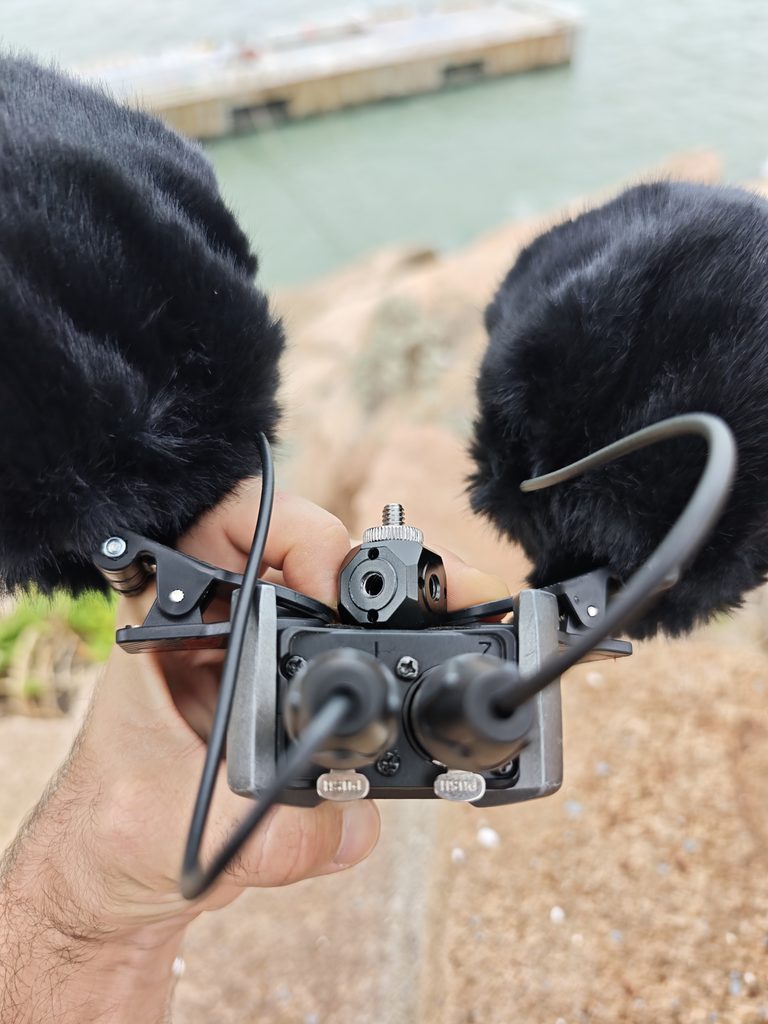
To achieve this, I decided to enclose each microphone entirely, including its suspension and cable connection.
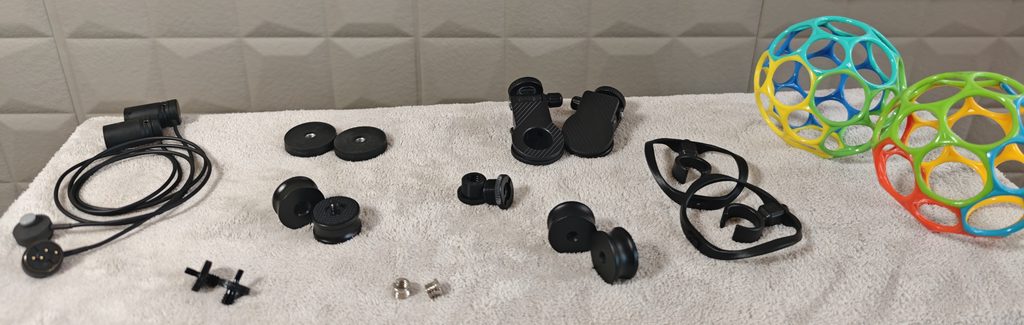
I now use custom ETK cables with low-profile, right-angle MZK connectors. These help minimise the space and weight around each microphone. For suspension, I use hoops from Radius Windshields, which hold the microphones in place inside the enclosure.
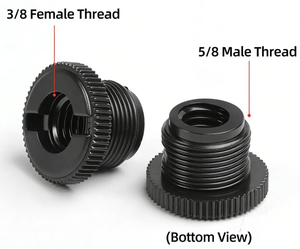
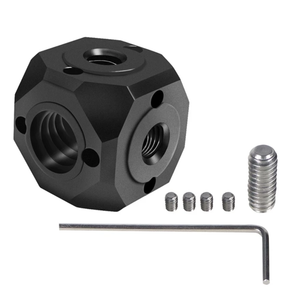
The outer structure is made from 4-inch O-balls. They create a lightweight spherical enclosure around each microphone, providing enough space for the suspension while remaining robust, easy to transport, and relatively affordable. Various screw adapters are used to connect all the components together.
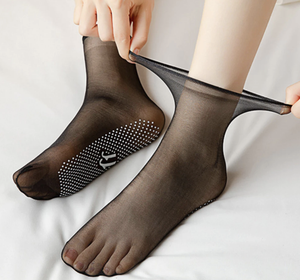
For the wind protection itself, I cover each O-ball with three layers of stretchable nylon socks. This provides a useful first layer of protection against light wind. When stronger wind protection is needed, I add fur covers on top. The covers designed for the Cinela Leo are compatible, although I have also found that the deadcat covers made for the Blue Snowball microphone work well.
Magnetic mounting and modularity
Another important change is the mounting system. I wanted to make the rig as modular as possible, allowing me to switch between a conventional clip and a magnetic mount.
I use a Zoom F3 as the recorder, together with Magsin extendable bars and a Fotopro tripod. The whole setup is relatively compact and straightforward to carry and assemble.
The modular design also gives me several possibilities. I can adjust the spacing between the microphones, hold them directly in my hands, or attach them to different objects and surfaces depending on the environment. This flexibility is one of the things I appreciate most about the new configuration.
The magnetic mounting system is still relatively new to me, and I want to experiment further with it. I have not come across a commercially available system that offers quite the combination I was looking for, so building my own seemed like the most sensible approach.
There are, of course, a few limitations to consider. Although the magnets themselves are strong, there is no secondary locking mechanism to prevent the components from separating. Accidental physical pressure can dislodge them, for example when putting the assembled system into a bag.
For demanding on-set work involving frequent movement and a rig that needs to remain absolutely secured, this might not be the most suitable solution. However, for my own solo field recording, where movements are generally slow and controlled, it works very well. The magnetic connections have also proved surprisingly reliable, even in strong wind.
I can always use conventional 1/4-inch threaded connections when needed, but for now, magnetic mounting feels like the right solution for the way I work.
My desert-island choice for 2026
Of course, I use plenty of other equipment depending on the recording situation, including different microphones and configurations. No single setup can cover every possible scenario.
But if I had to choose just one rig to take with me in 2026, this would be it. It offers a good balance between sound quality, reliability, flexibility, and ease of use. Most importantly, it allows me to spend less time dealing with equipment and more time actually recording.
That, ultimately, is what I am looking for.
Full equipment and component list
Microphones and recording
- Sennheiser MKH 8090 (x2)
- ETK Cables, low-profile MZK connectors
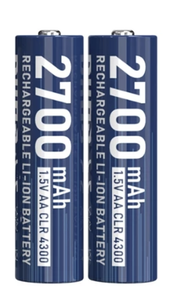
- Zoom F3 recorder with Xtar batteries
Wind protection and suspension
- Classic O-ball, 4-inch (x2)
- Radius Windshield suspension hoop with 20 mm microphone clip
- Ultra-thin invisible elastic nylon socks (bag of 10, 5 pairs)
- Fur covers compatible with the Cinela Leo or Blue Snowball
Mounting hardware and adapters
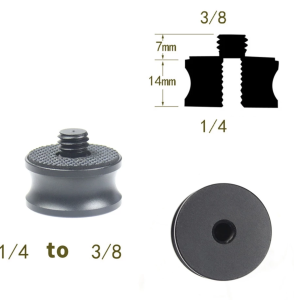
- Feichao 1/4-inch female to 3/8-inch male thread screw mount adapter (x2)
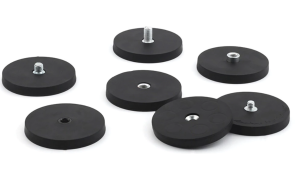
- Feichao strong magnetic mount, round rubber base, 1/4-inch thread (3 male / 1 female)
- Universal microphone stand adapter, 3/8-inch female to 5/8-inch male
- XT-XINTE universal 1/4-inch / 3/8-inch screw magic cubic mount
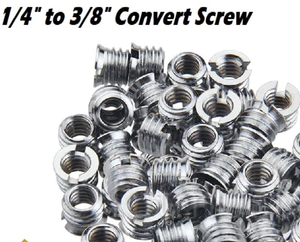
- 1/4-inch to 3/8-inch conversion screw
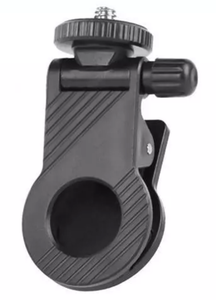
- Mini fill-light clip with 1/4-inch thread
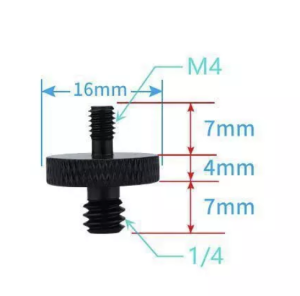
- Dual-nut tripod conversion screw, 1/4-inch to M4
Support
- Magsin extendable bar, 70 cm
- Fotopro tripod