Nature and conservation have always been at the core of both my work and my personal philosophy. For the past decade, most of my professional life has revolved around creating sound effects libraries, travelling to remote places and recording the natural world. But when Raymond, the producer of Itam, contacted me about creating the soundtrack for the documentary he was working on, something immediately clicked.
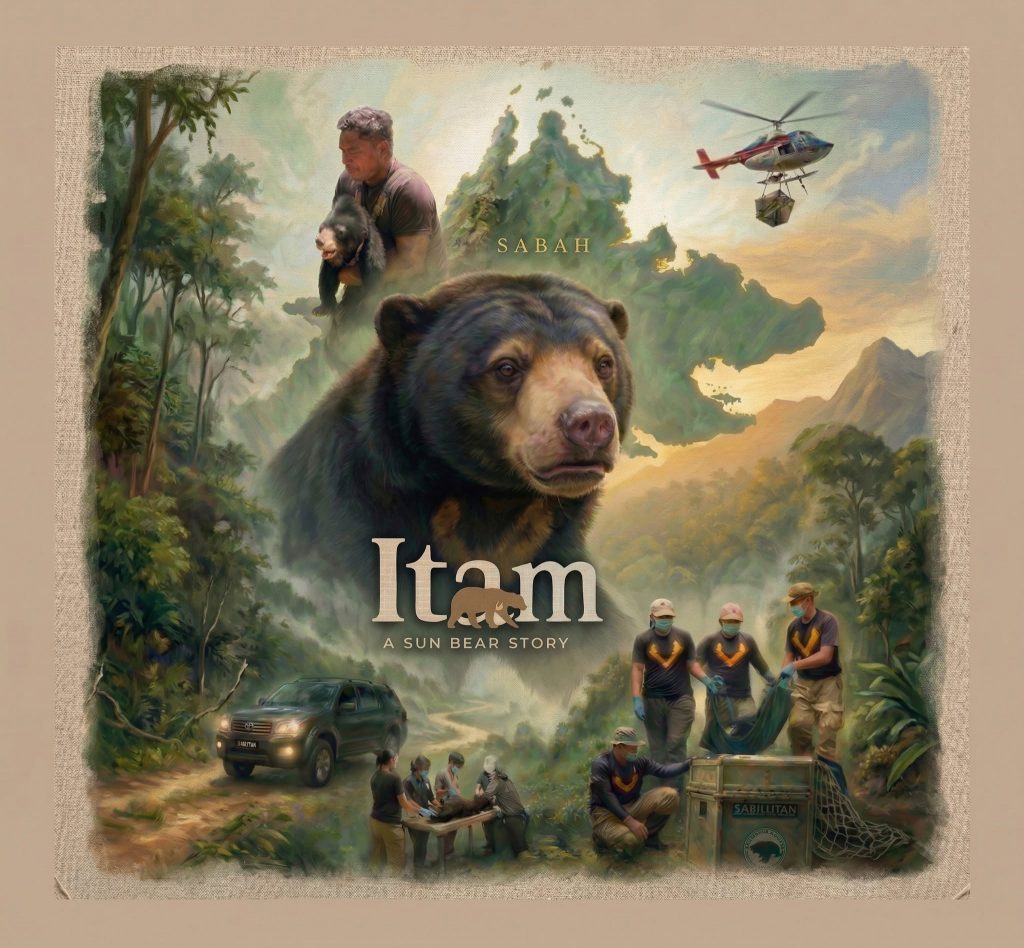
Itam is a feature-length documentary about the conservation of the Malayan sun bear in Borneo. It brought together almost everything I care about: wildlife, conservation, the Bornean environment, immersive sound, and the opportunity to finally use my own field recordings for a real film project.
It felt like a project I was meant to take on.
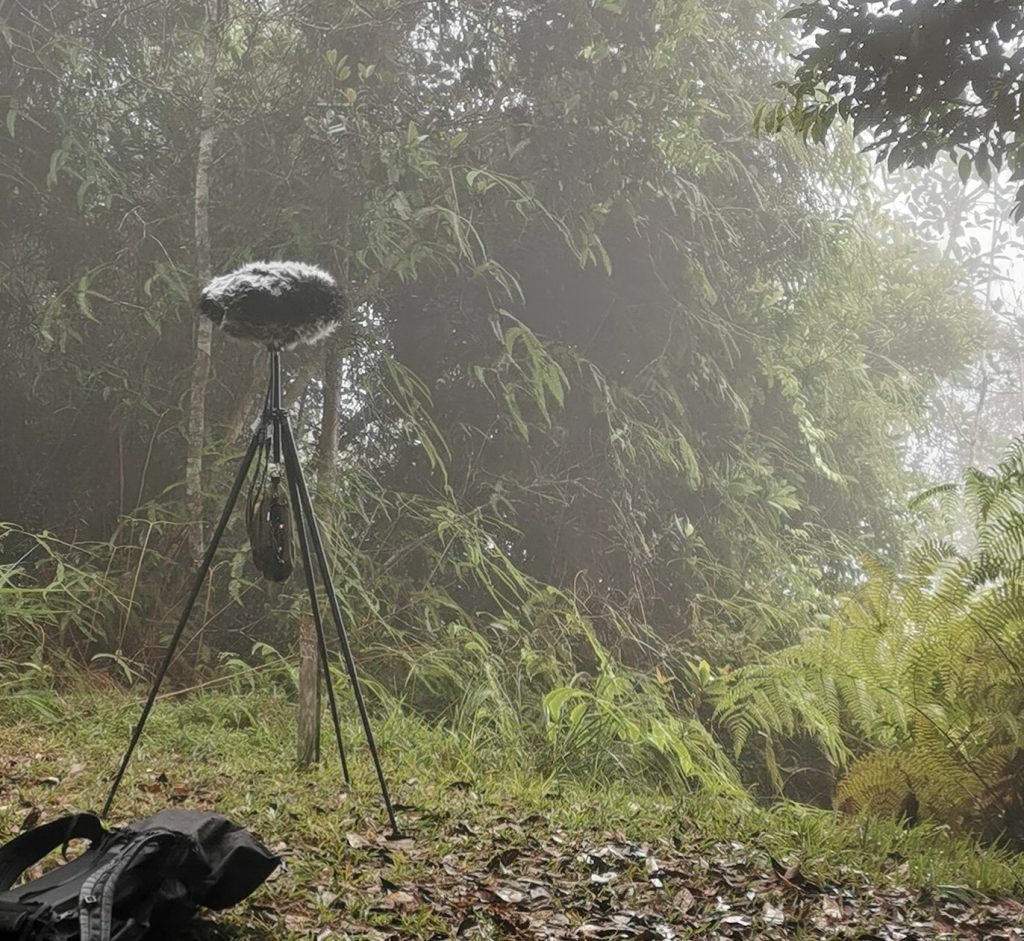
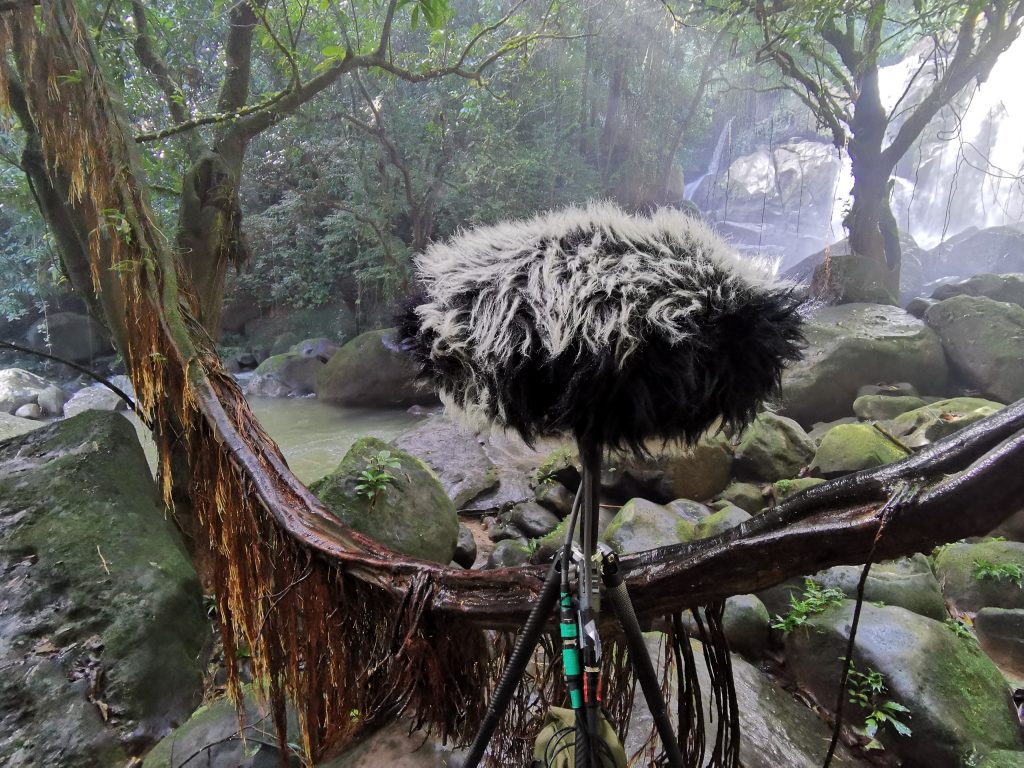
Over the previous three years, I had travelled to Borneo four times, specifically collecting immersive ambiences using my Schoeps ORTF 3D surround setup. I had accumulated a huge amount of material, much of it recorded specifically with immersive formats such as cinema and surround playback in mind.
Now I had a film that could give those recordings a completely different purpose.
There was also something particularly meaningful about the fact that Itam was a Malaysian production, made by local people and focused on a local conservation issue. Raymond is from Penang and lives relatively close to my temporary base there, so the collaboration came together quite naturally. Working on a local project with local people felt much closer to my own aspirations than simply contributing to another Western-produced documentary about Southeast Asia.
Most importantly, Raymond gave me carte blanche over the entire sound aspect of the film.
That meant everything from gathering and preparing the sound material to editing, ambience, Foley, sound effects, music selection and, eventually, the final mix.
In other words, I ended up building almost the entire soundtrack from scratch.
And I quickly discovered that there was a lot more to it than I initially imagined.
1. Building the Sound Palette
From the beginning, I knew that the final soundtrack would be in surround, at least 5.1. That decision influenced almost everything: my DAW template, the way I organised the project, and especially the way I approached the sound material.
One important detail was that I had not been involved in the filming itself. By the time I joined the project, the movie had already been shot.
And when I received the first cut, it was completely silent.
There was no temporary soundtrack, no guide ambience, nothing to suggest what the final soundscape might become.
Fortunately, there was some audio recorded during the shoots by a student sound recordist. The material was not always easy to work with. The recordings were mostly mono, and the naming and organisation were fairly basic. It felt a little like being handed a haystack and being told there were a few interesting sounds somewhere inside it.
There was also plenty of unwanted production noise: crew movements, equipment, drones, and, of course, the almost omnipresent cicadas of the tropical forest.
But there were some real gems hidden in there.
The original sun bear recordings were particularly valuable. Bears are generally not very vocal animals, so there were only a handful of useful recordings. By carefully cleaning and editing those original production sounds, I was able to build a small but useful palette of authentic sun bear vocalisations.
For the ambiences, however, I had an enormous advantage.
I could go back into my own Borneo archives.
It wasn’t always straightforward. Some of these recordings had been made in extremely humid conditions, and humidity had introduced various technical problems and glitches into the recordings. I had to clean them extensively and carefully select the usable sections.
Over the years I had recorded large amounts of jungle ambience using my Schoeps ORTF 3D setup, specifically with immersive applications in mind. I spent a lot of time going through these recordings, selecting sections that could help establish the different environments and times of day represented in the film.
But once I started putting the pieces together, I realised just how valuable that archive had become.
It was essentially a ready-made sonic library of Borneo, recorded over many different days, locations and times of day.
Foley in the Forest
Foley was another part of the project that I hadn’t initially expected to take on myself.
Under different circumstances, this could have been handled by a dedicated Foley artist or studio. But the schedule and budget made that difficult, and I was also curious to see how far I could take it myself.
It turned into one of the more enjoyable parts of the project.
Fortunately, my temporary base was right next to a patch of forest, so I had access to plenty of natural materials.
I collected different types of leaves, from very dry ones to fresher vegetation, to recreate footsteps and movements through the Bornean forest. I collected pieces of bark for scenes involving sun bears climbing and gripping tree trunks. I experimented with different types of soil and earth, and tried various shoes to recreate the footsteps of the rangers.
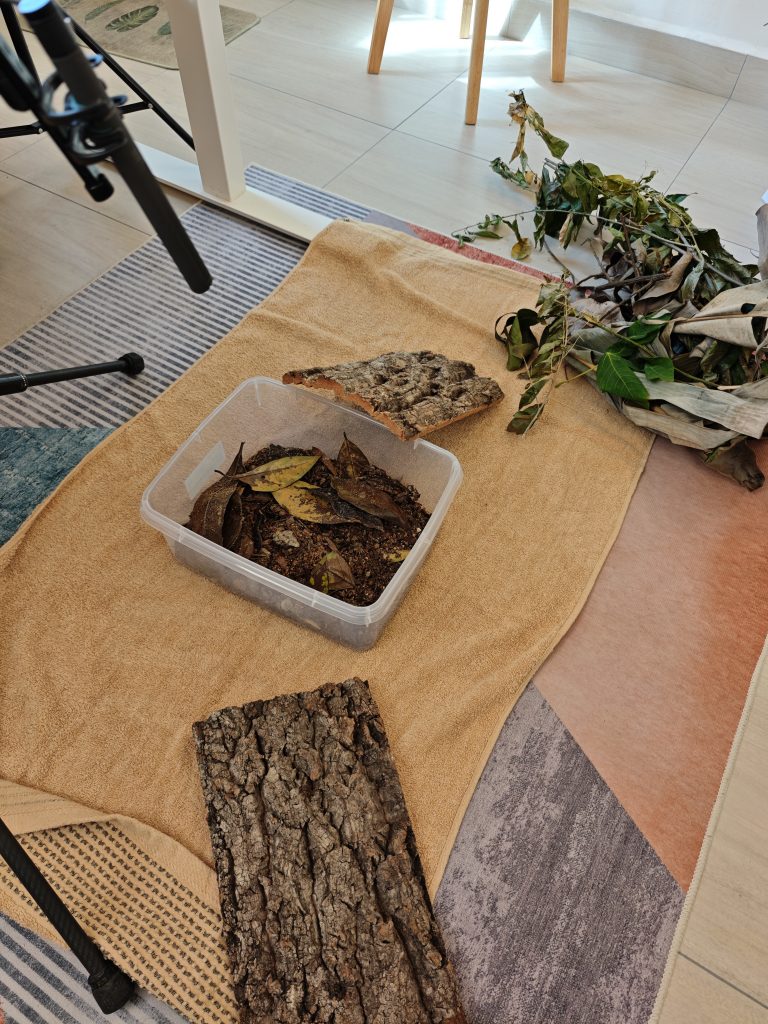
For some scenes involving cages, I even used metal cabinets to create the appropriate sounds.
It was a very hands-on process: finding a physical object, recording it, listening back, trying something else, and gradually building up a convincing sonic version of what was happening on screen.
Sound Effects and the Sun Bears
I also searched through my own sound library for additional sound effects and created a few stingers where appropriate.
But I deliberately used these sparingly.
I wanted the soundtrack to remain grounded in reality. This was a conservation documentary, not an action movie, and I didn’t want sound design to become noticeable simply for the sake of being impressive.
The sun bear sounds received perhaps the greatest amount of attention.
I had some recordings of my own, but the original production recordings contained some particularly interesting material. I spent a lot of time selecting the sounds that felt most believable for each scene, then carefully adjusting their timbre, speed and pitch where necessary.
The goal was not simply to make the bear audible.
The goal was to make the bear believable.
And, hopefully, to bring some emotion with it.
I am quite satisfied with how those sounds eventually came together.
Music and Voice
The music was handled differently.
Raymond had already selected a library of stock music, partly because there was limited budget available for original composition. We listened through the material and selected pieces that could work with different scenes. Sometimes Raymond chose the music, sometimes I did.
The voice-over was another major element of the soundtrack. It is present throughout much of the movie because it carries a large part of the story.
A local Malaysian voice actor recorded all three language versions himself: English, Bahasa Melayu and Mandarin.
I received the voice recordings later in the process, and interestingly, some voice-over changes were still being made even after the final mix.
2. Finding the Right Sounds for the Cut
One of the most instructive parts of the project was discovering how my own field recordings could be used to shape the atmosphere of an entire film.
I began dissecting my archive and looking for sounds that could follow the emotional and environmental progression of the story.
There was an interesting coincidence in the structure of the film.
Although the story itself represents events occurring over a much longer period, the way the documentary unfolds follows something close to a complete tropical day.
It begins in the early morning, moves through the day, reaches a tropical rain shower around the middle of the day, continues towards evening and night, and eventually returns to the following morning.
That gave me a natural sonic structure to work with.
Because I have spent so much time recording at different times of day in Borneo, I had a huge range of material to choose from. I could find morning choruses, daytime insect activity, rain, changing forest textures and nighttime environments, then edit them together to create a coherent sonic journey.
In some ways, I began to wonder whether the movie could almost have worked with nothing but these ambiences.
The recordings were immersive enough to transport the audience into another environment even without dialogue or narrative.
Of course, that alone would not tell the story.
The music, voice-over, Foley and sound effects were essential in giving those environments meaning and helping the audience understand what was happening.
The local voice actor also did an excellent job. His performance brought a great deal of meaning and personality to the narration.
Many of the additional sound effects came from my own library, carefully selected for each scene. And even during the mix, I kept discovering sounds that were missing.
This was partly because I hadn’t fully understood the scope of the project when I first started.
And there was another problem.
Time.
I had roughly one week to do the bulk of the soundtrack work before the final mix.
I received the final video cut only about a week before the scheduled mix, so there was an enormous amount to accomplish in a very short period.
Fortunately, I had already prepared some of the assets beforehand, which made the situation manageable.
But it was still intense.
3. Taking Itam Into the Cinema
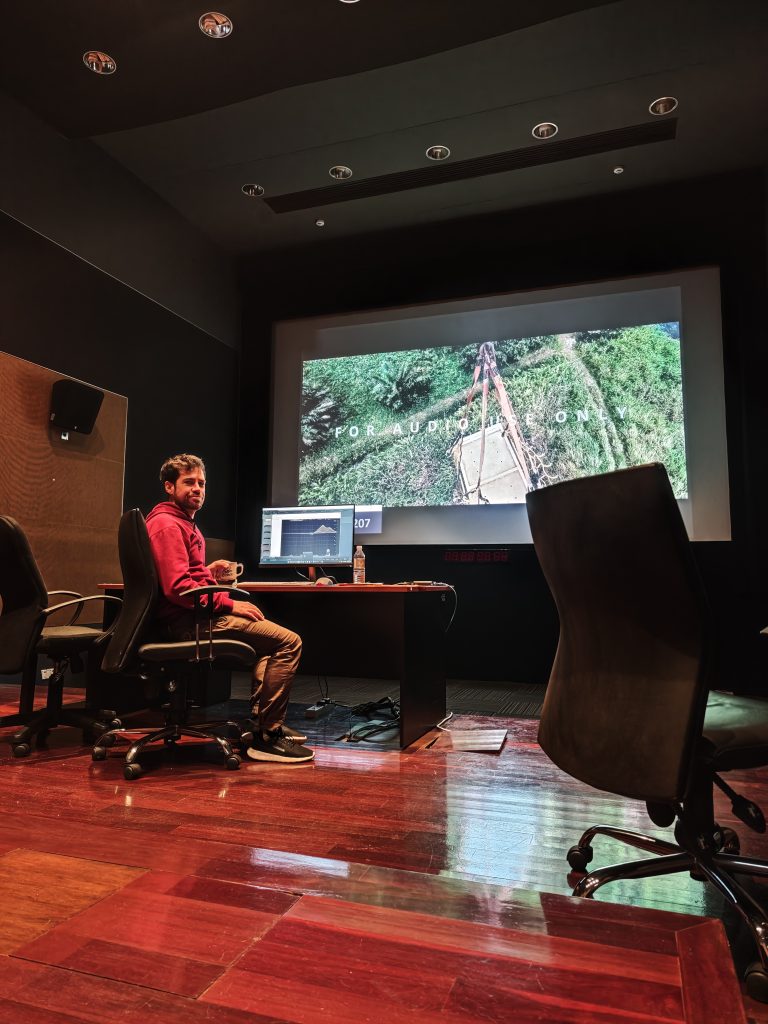
For the final mix, Raymond booked a studio at FINAS in Kuala Lumpur, one of Malaysia’s best-known post-production facilities.
The in-house team was extremely helpful in getting everything configured, including the cinema speakers and screen.
The setup itself was surprisingly quick.
And I was excited.
As a field recordist, I spend most of my time listening through headphones, monitors or relatively small playback systems. Getting to hear my own recordings through a proper cinema system was a completely different experience.
It also gave me the opportunity to make mixing decisions in an environment much closer to where the audience would eventually hear the film.
There was just one problem.
The soundtrack was not completely finished.
One week simply wasn’t enough time to fully prepare every ambience, Foley element, sound effect and music cue to the level I would normally want.
Under normal circumstances, I think this kind of work would take at least two weeks, probably more, especially with a single person handling almost the entire soundtrack.
I even asked my brother, who is based in France, to help with a particular task so I could reduce some of the workload.
Still, most of the most important scenes and elements were ready.
We ended up doing two final mix sessions with Raymond because it was impossible to complete the entire movie in a single session.
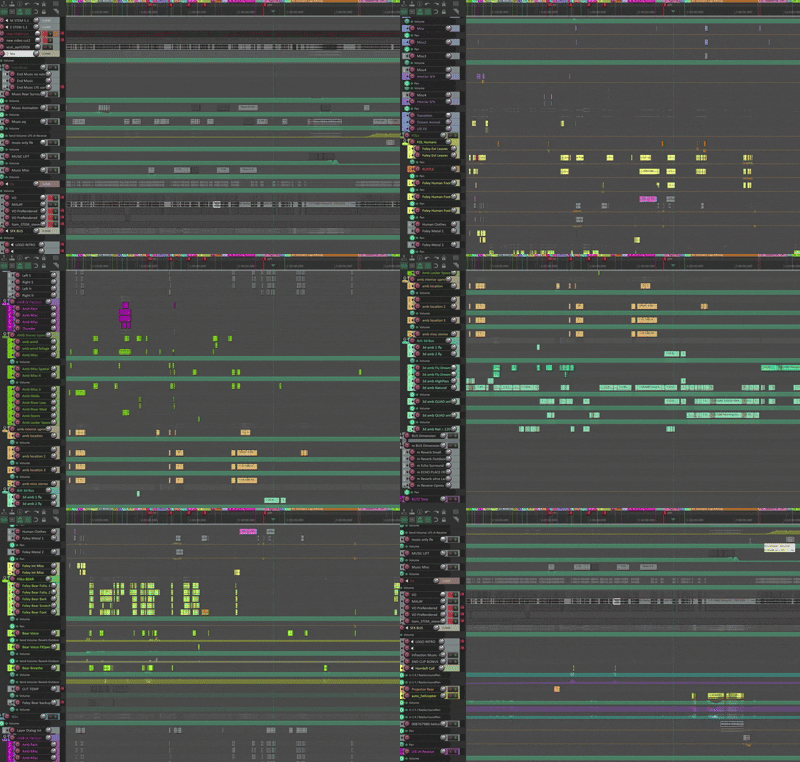
During the mix, I made extensive use of surround panning, subtle surround reverbs, upmixing for some mono and stereo sources, and automation.
One of the most interesting discoveries happened during these sessions.
I had focused so heavily on the natural environments and sun bear scenes that I had overlooked something rather obvious.
There were quite a few scenes involving people at the conservation centre.
Those scenes needed human background activity.
They felt strangely empty compared with the forest scenes.
So I had to go back in and add another layer of human ambience to make those environments feel alive.
It was actually a funny realisation.
When I first started the project, I imagined I was working on a nature documentary dominated by sun bears.
But as the edit developed, I realised there were actually more scenes involving humans than sun bears.
And then there was the helicopter.
That was probably the most fun element to mix in the cinema.
There were some original helicopter recordings from the shoot, although they were mono, so I searched for additional material and layered different recordings together. By combining them with creative surround panning, I could make the helicopter move through the sound field and around the audience.
On a large cinema system, it was surprisingly powerful.
At the end of the second session, we listened through the entire movie one final time.
I think we worked until around 4 a.m.
There were still a few last-minute modifications here and there, but eventually, the soundtrack was done.
4. The Problems You Don’t Discover Until After the Mix
The most challenging part of the project, in retrospect, may actually have been what happened after the final mix.
I had assumed the picture was locked.
It wasn’t.
Some modifications were still required after the final mix, and this is exactly the kind of situation that can become a nightmare for a sound editor.
Because I travel constantly for field recording, I don’t carry every project and every sound file with me. Once a project has been delivered, the working files are usually archived on my server.
So when the director requested another modification while I was in the countryside of China recording, getting the project back onto my local system was not straightforward.
I would have needed to retrieve and synchronise roughly 80 GB or more of project data just to make the changes.
It was a good reminder that the workflow doesn’t necessarily end when you leave the mixing room.
One Week Is Not Enough
Another major lesson was the amount of time allocated to the soundtrack.
From the delivery of the final cut to the final mix, I had little more than a week.
That is simply too short for this kind of work when one person is responsible for ambience editing, Foley, sound effects, music, dialogue and the overall sound design.
The schedule could have worked much better with additional collaborators.
For future projects, I would want the soundtrack schedule to be estimated more realistically and, when appropriate, divided between several people.
It would not only reduce the workload, but also give each element more time to receive the attention it deserves.
More Production Sound Would Have Helped
Another thing that would have made the process easier was having more on-set recordings.
The existing material was useful, but more recordings, more variety and different microphone formats would have provided a much larger palette to work from.
Stereo recordings, more focused effects, and additional recordings of specific actions would have been particularly valuable.
Even having a temporary soundtrack already synced to the edit would have helped enormously.
These things may seem minor during production, but they can make a huge difference once the post-production process begins.
5. The Cinema Mix: A Lesson I Won’t Forget
There was one final lesson that I did not discover until the movie was actually released.
Cinema sound systems are not all identical.
They are calibrated differently, and the way a mix translates from one room to another can sometimes be surprising.
For Itam, we had mixed the movie in one room at FINAS. Ideally, I would have liked to listen to the final mix in several different cinema environments before the DCP was finalised.
We didn’t have that opportunity.
During the premiere, I immediately noticed something.
The centre channel was much louder than I had expected.
Because the voice-over was primarily placed in the centre channel, every new sentence felt unusually prominent and, at times, almost aggressive.
That was not the balance we had created at FINAS.
And by the time I discovered it, the DCP had already been printed and the movie had been released.
I am still not completely sure what caused the difference. It may have been related to the calibration of the theatre, and it seems that some cinemas may boost the centre channel to improve dialogue intelligibility.
That can make sense for many types of films.
But Itam is a very different kind of movie.
The voice-over sits above relatively quiet, natural environments. There are no constant explosions, action sequences or dense dialogue scenes competing for attention.
A heavily boosted centre channel therefore changes the balance quite dramatically.
For me, this was a major red flag and an important lesson for future projects.
I will certainly want to check and re-check this aspect of a cinema mix, and ideally listen to the soundtrack in more than one theatre before final delivery.
6. What I Learned From Itam
Despite all the challenges, I genuinely loved working on Itam.
The project fitted remarkably well with the direction of my work and with the things I care about personally.
For the first time, I had the opportunity to become a user of my own sound libraries in a real-world production.
That might sound like a small distinction, but for someone who spends so much time creating sound libraries, it was an eye-opening experience.
When you record a sound and prepare it for a library, you think about microphone technique, noise, metadata, editing, file formats and usability.
But using those same recordings in a film reveals a completely different set of questions.
Does the recording actually work in context?
Does it support the image?
Does it create the right sense of space?
Can it survive a surround mix?
Does it feel natural when layered with Foley, dialogue and music?
And perhaps most importantly: does it help tell the story?
Working on Itam gave me the chance to answer those questions firsthand.
It also made me look at my own sound library differently. Some recordings that I had considered excellent in isolation turned out to be less useful in a narrative context, while other recordings became incredibly valuable once they were placed against the right image.
In that sense, the film became a real-world test of my own archive.
And then there is the bigger picture.
I have spent many years travelling through tropical environments and recording them, including four trips to Borneo specifically for immersive sound. Being able to take those recordings and use them to help tell a story about the conservation of one of Borneo’s most fascinating animals felt particularly meaningful.
Itam is now being screened in cinemas across Malaysia, as well as in Singapore.
Knowing that the sounds I recorded in those forests are now being heard by cinema audiences, helping create a sense of place and bringing attention to the conservation of the Malayan sun bear, is probably the most rewarding part of the whole project.
For me, that is what made Itam special.
It wasn’t simply an opportunity to make a soundtrack.
It was an opportunity to take years of listening, travelling and recording, and put all of that experience in the service of a story and a cause that genuinely matters to me.